Most rooms need 1–2 gallons of paint per coat for the walls alone, but the exact number depends on your room's size, how many doors and windows cut into the wall area, and whether you're doing one coat or two. Punch your numbers into the calculator below and you'll get an exact gallon count, a cost estimate by paint quality, and a DIY-vs-pro comparison in seconds.
No more buying two extra gallons "just in case" or running out on the second coat with wet paint still drying on the roller. Here's how to use it, plus the math behind the numbers so you know exactly what you're getting.
- Use the Paint Calculator
- How We Calculate Your Paint Quantity
- What Paint Actually Costs by Quality Tier
- DIY vs. Hiring a Pro
- How to Avoid Running Out (or Over-Buying)
In this guide
Use the Paint Calculator
Enter your room's length, width, and wall height, then tell it how many doors and windows you're cutting around. The results update as you type — no submit button, no waiting.
Your room
1. Paint you'll need
-- gallons
-- sq ft of paintable wall area
2. Cost by quality
$--
Paint only, before supplies
3. DIY vs. pro
DIY
$--
Paint + ~$40 in supplies
Hire a pro
$--–$--
Materials + labor, typical range
Estimates only — assumes about 350 sq ft of coverage per gallon and standard door/window cutouts. Actual needs vary by paint brand, surface texture, and color change. See how we calculate these estimates.
How We Calculate Your Paint Quantity
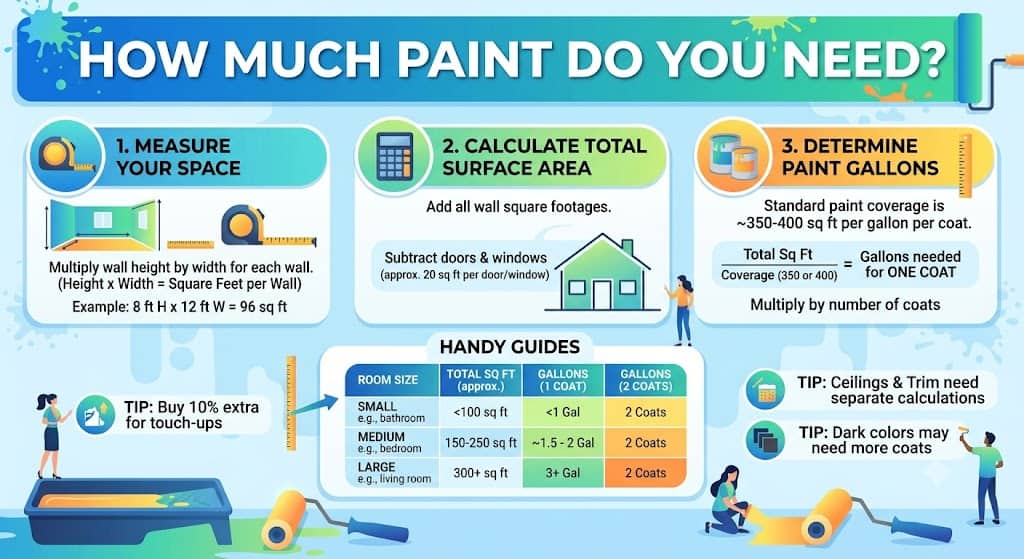
The calculator starts with your wall area: it multiplies your room's perimeter (twice the length plus the width) by your wall height to get the gross wall area, then subtracts about 20 square feet for each door and 15 square feet for each window — standard sizes for interior doors and windows.
That net wall area gets multiplied by your number of coats, then divided by 350 — the industry-standard coverage estimate of about 350 square feet per gallon for a single coat on primed drywall. Textured walls, unprimed surfaces, or a big color change (dark over light, or vice versa) can pull that number down closer to 250–300 square feet per gallon, so the calculator's result is a solid starting point, not a guarantee down to the last drop.
Two coats is the right default for almost every interior repaint. One coat can work if you're using a paint-and-primer-in-one product on a wall that's the same color family as before, but two coats is what gives you an even, streak-free finish that hides roller marks and old wall imperfections.
What Paint Actually Costs by Quality Tier
Interior paint in 2026 generally splits into three tiers:
- Economy (~$20/gallon): Thinner coverage, often needs a third coat for full opacity, and tends to show burnishing (shiny patches) faster where walls get touched or wiped.
- Standard (~$35/gallon): The sweet spot for most homeowners — good hide in two coats, reasonable washability, and a finish that holds up for 5–7 years before it needs a refresh.
- Premium (~$55/gallon): Better stain resistance and scrubbability, truer color depth, and often a manufacturer warranty — worth it for high-traffic rooms like kitchens, hallways, and kids' rooms.
Paying more per gallon for a paint that truly covers in two coats can end up cheaper than buying extra cans of a bargain paint that needs three.
DIY vs. Hiring a Pro

The DIY estimate above just adds roughly $40 in supplies — tape, a roller, a brush, and a drop cloth — on top of your paint cost. The professional range adds typical labor of $1.50 to $3 per square foot of wall, which is why a pro quote can come in two to four times higher than materials alone. Labor is the expensive part of painting, not the paint.
If your walls are already in decent shape (no major patching, no wallpaper to strip), painting is one of the most beginner-friendly projects in the house. If you're dealing with popcorn ceilings, extensive drywall repair, or ceilings over 10 feet, that's when the honest math starts favoring a pro. We break down exactly when each option wins in Painting a Room Yourself vs. Hiring a Pro: The Honest Math.
How to Avoid Running Out (or Over-Buying)
A few habits make the calculator's number even more reliable in practice:
- Buy from the same batch. Paint is mixed in batches, and color can vary slightly between them. If you need more mid-project, bring your original can (or its batch number) to match it exactly.
- Round up, not down. The calculator already rounds to the nearest half gallon, but if your walls are heavily textured or you're covering a bold color, buy the next size up rather than cutting it close.
- Keep the leftover. A labeled quart of leftover paint is worth its weight in touch-up convenience a year from now — store it somewhere that won't freeze.
Before you crack open that first can, make sure your walls are actually ready for it — a properly prepped wall is the difference between paint that lasts one year and paint that lasts seven. Here's exactly how in How to Prep Walls for Painting (So the Paint Actually Lasts).