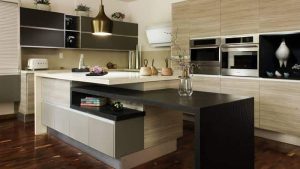
Floating kitchen cabinets are one of the best ways to break away from the dreariness of conventional, stacked cupboards.
Those cabinets appear to drift in mid-air, wall-mounted rather than resting on the floor or on top of other cabinetry. It's a visually striking, sleek look.
Using floating cabinets makes the floor feel more open and the kitchen feel considerably more spacious, giving the room a modern, layered look and an airy feel.
It helps to have a consistent shelving theme throughout so it stays in line with your overall goals for the floating kitchen look.
In this guide
How Are Cabinets Floated?
Mounting floating kitchen cabinets is fairly straightforward, but you need a solid supporting structure to keep them level while you work. Here's the general process:
- Start by deciding how high off the floor the cabinets will be mounted. You can build a temporary support frame out of wood to hold the cabinet at the right height while you secure it. This frame keeps the cabinet stable and level while you work.
- Once the cabinet is properly positioned, open the doors and mark where you'll drill mounting holes on the cabinet's inner back panel.
- Drill smaller pilot holes first to check whether you can hit any wall studs. If a hole lines up with a stud, you can screw straight through the cabinet into it for a very solid mount.
- With four holes marked on each cabinet, you'll drill through the drywall into the wall cavity behind it. For mounting into open wall space without a stud behind it, you'll need toggle bolts instead.
- A toggle bolt works by having a spring-loaded wing that folds flat to pass through the drilled hole, then springs open behind the drywall once inside, gripping the back of the drywall as you tighten the screw.
- Each cabinet generally requires four toggle bolts, one per corner.
- Fold the wings of each toggle bolt and push them through the drywall, then pop them open on the other side. It helps to pull outward on the bolt as you twist it, so the toggle engages properly inside the wall.
- Tighten every bolt loosely at first and check that the cabinet sits level against the wall. With the bolts still a bit loose, you can still adjust the cabinet's position slightly, which is the time to make any corrections.
- Tighten the bolts one at a time until all four are snug and the cabinet is secure against the wall. Don't overtighten, or you risk pulling the toggle straight out through the drywall.
Consider adding washers between each bolt head and the inner back panel of the cabinet for extra support, and repeat this whole process for each floating cabinet you install.
Where cabinets sit side by side, you can also drill through their adjoining inner frames and bolt the front edges together in a couple of spots, which helps keep the whole run level and connected.
Finish up by installing door handles. You can also remove the temporary wooden support frame piece by piece once everything is secure.
Before starting this process, it's worth planning out your layout using one of the many kitchen design software programs available today.
Do Base Cabinets Normally Sit on the Floor?
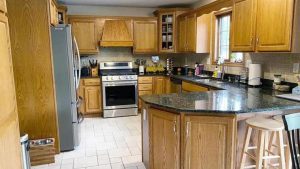
Base cabinets, the real workhorse of most kitchen designs, are typically installed on the floor and serve as the foundation for countertops and easily accessible storage.
Base cabinets also help define the overall layout of a smaller kitchen.
Because they're typically anchored to the studs in the back wall, they read as a permanent, built-in part of the kitchen.
Base cabinets usually have either visible legs or legs hidden behind a wood panel called a toe kick. That said, some homeowners choose to have their base cabinets float instead.
A typical kitchen base cabinet has a toe kick of around 3.5 to 4 inches before the cabinet box itself begins.
By floating kitchen base cabinets roughly 10 inches off the floor instead, homeowners can gain some extra visible floor space in a smaller kitchen, and the visual contrast is far more dramatic than a standard toe kick.
Lower Kitchen Cabinets
A lower cabinet run generally needs to accommodate everyday kitchen storage and décor sitting underneath it.
Base cabinets typically offer the most storage in a kitchen, with a standard depth of about 24 inches.
If you'd like your lower cabinets to float, hanging them around 10 to 12 inches off the ground is a common approach. A floating kitchen island can round out the look and make a real difference stylistically.
A floating island is typically defined by extended countertops and cabinet sides with visible space beneath them. There's no fixed rule for exactly how far these need to extend to read as a "floating" look.
A deep toe kick painted in a darker color can also help create the illusion of a floating design even without a true float.
Related >> When Remodeling, When Do You Paint?
Standard Kitchen Base Cabinet Storage
Because floating cabinet boxes are generally shorter than a standard floor-mounted base cabinet, you'll typically lose somewhere around 2 to 6 inches of storage space.
The exact size of the floating cabinet boxes, and how much storage space you give up as a result, will depend on the specific cabinet manufacturer and product line you choose.
Can You Install Kitchen Cabinets on a Floating Floor?
Floating floors have become very popular because they're so easy to install.
Cabinets, by comparison, can be a lot more involved to put together and install. Still, whether you're remodeling or building new, both of these choices can have a real impact on the finished kitchen.
Cabinets are where you keep everything from coffee mugs to cereal boxes, so we took a closer look at how they interact with floating floors underneath them.
Floating floors are often associated with laminate, but the category also covers a range of other materials.
As a result, floating flooring is a popular way to replace or cover existing flooring without tearing it out. That said, the order you install your wall cabinets, base cabinets, and flooring in really matters.
Keep reading to see how cabinets, floating floors, and traditional flooring compare.
Should You Install a Floating Floor Under Kitchen Cabinets?
To start, consider the type of flooring you're using. Floating floors should never be treated like a typical fixed floor.
Under the sustained weight of heavy cabinets, floating floors can fail over time. You can look into wood laminate flooring separately to learn more about how it compares to solid hardwood.
Deciding what to install underneath your cabinets can be a genuinely contentious question.
Personal preference plays a role here, since there are real advantages and drawbacks either way, especially where your base cabinets are concerned.
It's worth thinking through which approach genuinely suits your own home, and staying aware of the practical and financial trade-offs of each option.
Floating Floors Installed Before Cabinets
You'll likely run into problems if you install floating floors and then place your base cabinets directly on top of them.
Floating floors get their name from the simple system of interlocking tongue-and-groove pieces that hold them together without being nailed or glued down. That makes them inherently less stable under sustained heavy loads than flooring applied directly to the subfloor.
Placing heavy, fixed cabinets on top of this kind of flooring puts a significant, concentrated load on it.
That sustained weight can eventually cause the floating floor to buckle or separate at the seams where the pieces lock together. It's also common practice to leave a small expansion gap around the edges of a room for floating floors.
Flooring professionals generally agree that wood-based flooring naturally expands and contracts with temperature and humidity changes.
Installing a large run of cabinets directly on top of a floating floor pins it in place and prevents that natural movement.
Since the floor can no longer expand and contract freely, the trapped stress has to go somewhere, which is exactly what leads to the buckling and separation problems mentioned above. This is why installers generally recommend fitting cabinets first, then working the floating floor in around them.
Traditional Flooring Installed Before Cabinets
With traditional flooring, solid hardwood or tile is installed directly onto the subfloor.
That means the materials are glued, nailed, or otherwise fixed in place. This gives a level of stability that a floating floor simply doesn't have.
As a result, this kind of flooring can hold up under the sustained weight of appliances and base cabinets much better over time, which pays off in the long run.
For instance, in terms of future flexibility, you'd have an easier time rearranging or upgrading the space down the road.
More importantly, this also means you can easily replace damaged upper kitchen cabinets without worrying about the floor underneath.
Installing this kind of flooring underneath brand-new cabinets is also generally considered more straightforward.
The floor height throughout the room will be consistent, and you won't need to worry about cutting flooring pieces to fit around cabinet edges after the fact.
You will end up buying more flooring material than you might expect, since it needs to run underneath the full footprint of the cabinets too. On the other hand, you likely won't need to buy and measure for quarter round trim around every edge.
Quarter round is a type of molding used to fill in small gaps, such as the one between flooring and cabinets or baseboards.